
23rd Sunday Homily in Ordinary Time, Year A
A warm homily on fraternal correction for the 23rd Sunday in Ordinary Time, Year A, with...
Read More →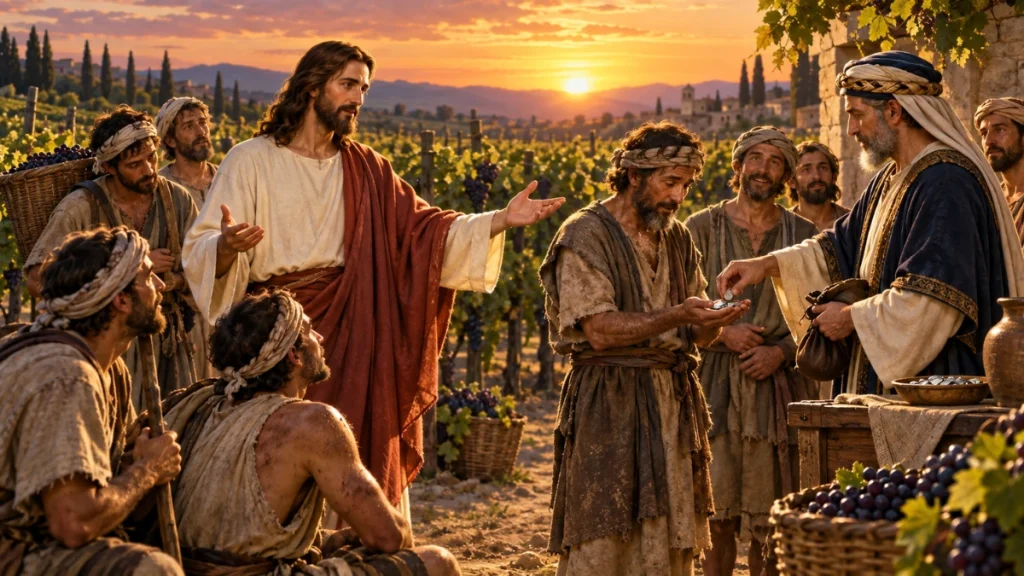
Sunday Homily for the 25th Sunday in Ordinary Time invites us into a vineyard where God’s mercy challenges our habit of comparing, counting, and deciding who deserves more. Read today’s Catholic Daily Readings here.
🌿 Twenty-Fifth Sunday in Ordinary Time — Year A
Every morning, men gathered near the village market and waited for someone to hire them. Landowners came early, looked at their hands and shoulders, and chose the strongest. Those selected walked away with relief. Their families would have food that evening.
Now imagine one man standing there as the hours pass. He wants to work, but nobody chooses him. Perhaps he is older. Perhaps an injury has made him slow. Perhaps the landowners simply look past him.
Morning becomes noon. Noon becomes afternoon. Each time someone arrives, other men are chosen. He remains behind. By evening, his deepest pain is no longer hunger. It is the feeling that nobody needs him.
Then, near the end of the day, another landowner comes. He sees the man and asks why he has been standing there. The man gives a painfully simple answer: nobody has hired him.
The landowner does not question his strength or blame him for being late. He sends him into the vineyard. The man works for only one hour. Yet when evening comes, the landowner places a full day’s wage into his hand.
That coin means food for his children. It means that he can return home without shame. More than payment, the coin tells him, “You were seen. You were wanted. Your life still has value.”
This is the part of the Gospel that we often miss. We quickly stand beside the workers who began early and complain about fairness. Jesus asks us to stand for a moment beside the worker whom nobody chose.
The landowner goes out again and again. He could have remained at home and waited for workers to find him. Instead, he enters the marketplace at different hours, searching for those who are still waiting.
This is the heart of God. Before we search for Him, He searches for us. Before we speak His name, He knows ours. Before we enter His vineyard, He comes into the marketplace of our sin, fear, disappointment, and loneliness.
Some people hear His call early. They receive the faith from their parents. They grow up praying, attending Mass, and serving the Church. What a blessing it is to spend the whole day in the Lord’s vineyard.
Others respond later. Some remain far from the Church for many years. Some damage their lives through wrong choices. Some remember God only when sickness, failure, or loss leaves them with nowhere else to turn.
When they finally return, God does not place them at the edge of His love. Through sincere repentance, He forgives them. In Confession, He restores the grace wounded or lost through sin. He brings them home and feeds them with Christ in the Holy Eucharist.
The workers who served all day become angry when they see the late workers receive a full wage. Their complaint sounds reasonable. They carried the heat and burden of the day. Why should those who worked for only one hour receive the same amount?
The landowner has not cheated them. He gives them everything he promised. Their joy disappears only when they begin looking into another person’s hand.
Comparison can make a blessed person feel poor. We may be grateful for our family until another family appears happier. We may value our work until someone else is promoted. We may be thankful for our gifts until another person receives praise.
This can also enter our life of faith. A person serves the parish for many years. Then a newcomer arrives and is given an important duty. Instead of welcoming the new person, the faithful worker begins to feel forgotten.
A quiet complaint rises within the heart: “I have served for so long. Why is this person receiving attention?” Nothing has been taken away, but comparison has made the heart narrow.
The blessing in our hand does not become smaller because God blesses someone else. His mercy is not a small loaf that must be divided into thin pieces. The grace given to another person takes nothing away from us.
The first reading helps us understand why God does not always act as we expect. Through Isaiah, God tells His people that His thoughts are higher than human thoughts and His ways are higher than human ways.
We see one hour of work. God sees a whole day of rejection. We see the sinner’s past. God sees repentance beginning within that person. We see someone entering the Church late. God sees a lost child finally coming home.
We see only the outside of a life. God sees the hidden wound, the silent prayer, the long struggle, and the small opening through which grace can enter.
God’s mercy does not ignore truth. It sees more truth than we do. We may know what a person has done, but we do not always know what that person has suffered. We may notice the late arrival, but we do not know how long that soul has been waiting for someone to offer hope.
This is why Jesus warns us against judging the place another person receives in God’s kingdom. We have read only one page of that person’s life. God has read the whole story.
The Gospel does not teach that faithful service is unimportant. Neither does it say that good and evil are the same. The workers who arrived early truly worked. Their labour mattered. Our prayers, sacrifices, duties, and works of love also matter.
Yet no one can stand before God and claim that heaven has been earned without grace. Even the desire to pray is touched by grace. Our strength to serve comes from grace. Our ability to repent is helped by grace. God moves first, and we freely answer Him.
Salvation is not a salary that places God in our debt. It is life with God. The final reward of the vineyard is not merely something that God gives. The reward is God Himself.
At Baptism, God calls us into His life. In Confession, He receives us when we have wandered away. In the Eucharist, Christ gives Himself as food for the journey. At every stage, God is not merely paying workers. He is forming children who can share His own life.
The workers who began early had already received a hidden blessing. They spent the whole day in the vineyard with the landowner. In the same way, those who have known Christ from childhood should not feel cheated when a sinner returns. They have enjoyed the grace of walking with the Lord through many seasons.
Saint Paul understands this truth in the second reading. He is caught between the desire to remain alive and continue serving the Church and the desire to depart and be with Christ.
For Paul, both life and death have meaning only because of Jesus. If he remains alive, he will work for Christ. If he dies, he will be with Christ. The vineyard, the labour, and the final reward are held together in one Person.
Paul is no longer counting how much he has done. He is not looking at another apostle and asking who will receive more. Christ has become his life.
This is the freedom Jesus wants to give us. A hired worker watches the clock and counts every task. A disciple looks at the Lord and says, “It is enough that I belong to You.”
When Christ becomes our reward, another person’s blessing no longer threatens us. We can rejoice when the lost return, when the weak are lifted, and when someone receives another chance. The Father’s joy becomes our joy.
Perhaps you feel like the worker who came early. You have prayed, served, forgiven, and carried responsibilities for many years. Now you are tired. You wonder whether anyone notices.
God sees you. Your years in His vineyard are not forgotten. But He asks you not to allow another person’s blessing to turn your service into bitterness. Do not let jealousy steal the joy of having walked with Christ for so long.
Perhaps you feel like the worker who came late. Much time has been lost. Mistakes have been made. You may believe that your life is too broken for God to use.
The landowner is still coming into the marketplace. Jesus has not stopped calling you. As long as you can hear His voice, it is not too late to enter the vineyard.
Saint Augustine entered the vineyard after years of wandering. The thief beside Jesus turned toward Him near the final hour of his earthly life. These stories do not make sin less serious. They show that Christ’s mercy is greater than the years we have wasted.
Do not wait for a better hour. Do not tell yourself that you will return to prayer after life becomes calm. Do not delay Confession because you feel ashamed. The God who calls you already knows your past, and He is still inviting you.
God may also be asking us to notice someone who has been left standing in the marketplace. It may be an elderly parent who feels forgotten, a student whom nobody chooses, a worker whose efforts are ignored, or a family member whom everyone judges by an old mistake.
The landowner did more than give the man work. He restored his dignity. Christians are called to do the same.
One invitation, one kind word, or one act of trust can tell a wounded person, “You are still seen. You are still needed. Your story is not over.”
This week, notice what happens within you when another person is blessed. If jealousy rises, do not feed it. Thank God for one grace already present in your life. Then pray sincerely for the person with whom you are tempted to compare yourself.
Look also for one person whom others have overlooked. Bring that person into the circle. Listen without rushing. Offer encouragement, friendship, forgiveness, or some useful responsibility. Let the generosity of the landowner pass through your hands.
At the end of the Gospel, the coin rests in the hand of the man whom nobody chose. The other workers see only an undeserved payment. The landowner sees a family that needs bread.
That is the difference between envy and mercy. Envy asks, “Why did that person receive so much?” Mercy asks, “What does this person need in order to live?”
Enter the vineyard with gratitude. Work faithfully without keeping score. Welcome those who arrive after you. And when God places the coin of mercy into another person’s hand, rejoice. It may be the answer to a prayer that you never heard and the bread that a waiting family desperately needs.
Lord Jesus, thank You for coming to find me and calling me into Your vineyard. Free my heart from jealousy, comparison, and the desire to keep score. Help me rejoice when You show mercy to another person. Through me, notice those who have been forgotten, welcome those who return, and encourage those who believe it is too late. Teach me to serve You faithfully until the evening comes. May You alone be my labour, my joy, and my eternal reward. Amen.
May we work with gratitude, welcome those who arrive late, and rejoice in the generous mercy of God. Read about today’s Korean Martyrs. 🙏

A warm homily on fraternal correction for the 23rd Sunday in Ordinary Time, Year A, with...
Read More →
Catholic Reflection for Sunday, 12 July 2026 — Listen to Reflection Your browser does not support...
Read More →
Catholic Homily for November 27, 2025 Thursday, November 27, 2025 Luke 21:20-28 We gather around tables...
Read More →Choose one simple response after prayerful reading.