
Korean Martyrs: Andrew Kim Taegon and Companions
The Korean Martyrs show what can happen when ordinary people treasure Jesus more than safety, comfort,...
Read More →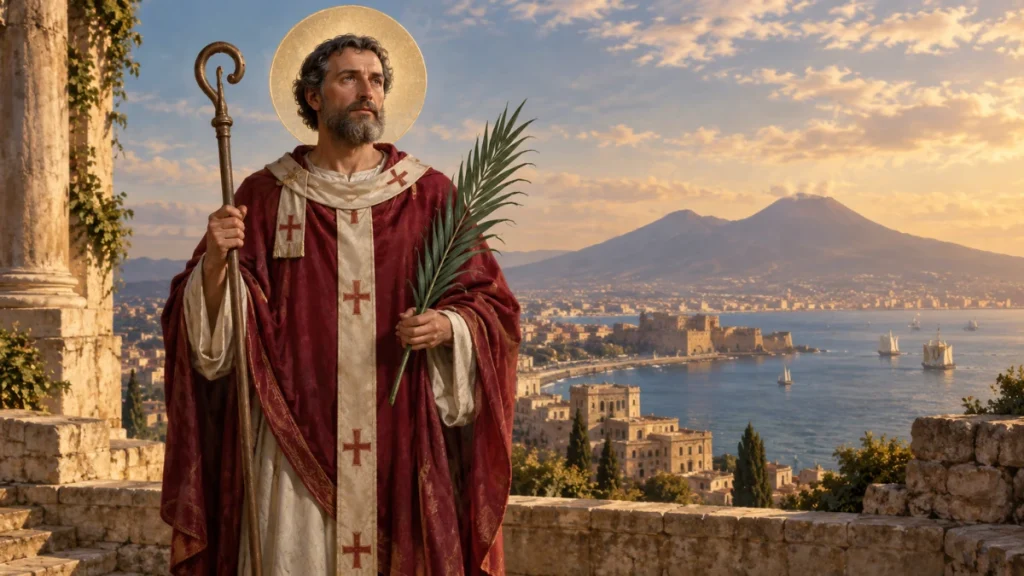
Saint Januarius was a bishop who refused to abandon Christ when public faith could lead to arrest and death. He gave his life during the persecution of Christians under Emperor Diocletian. Centuries later, the people of Naples still turn to him as their beloved patron and a sign of steadfast hope in times of danger. Read today’s Catholic Daily Readings here.
Saint Januarius, widely known by his Italian name San Gennaro, was an early Christian bishop and martyr. He is traditionally identified as the Bishop of Benevento in southern Italy.
Many details about his early life have not been preserved with certainty. The strongest tradition remembers him as a bishop who encouraged persecuted Christians and remained faithful to Christ even when that faith placed his own life in danger.
The Church honours him on 19 September, especially remembering his courage as a bishop and his witness as a martyr.
Januarius lived during the persecution connected with Emperor Diocletian at the beginning of the fourth century. Christians could be arrested for refusing to worship the Roman gods or offer sacrifice to the emperor.
A bishop had good reasons to hide. His arrest could place an entire Christian community in danger. Yet a bishop was also called to remain close to the frightened, imprisoned, and suffering members of his flock.
Ancient tradition connects Januarius with Christians who had been arrested near Pozzuoli. He did not protect himself by forgetting them. His concern for fellow believers brought him into danger.
Januarius was arrested with several Christian companions. Later accounts contain different details about the events leading to their deaths, so these details should be treated as tradition rather than certain history.
The central fact remembered by the Church is clear: Januarius and his companions were killed because they would not abandon their Christian faith. Their martyrdom is commonly placed around the year 305 near Pozzuoli.
The word martyr means witness. Januarius witnessed not only through preaching but also through the surrender of his life. His death declared that Christ was worth more to him than safety.
The Cathedral of Naples preserves a relic traditionally believed to contain the blood of Saint Januarius. At particular celebrations, including his September feast, the substance has often been observed changing from a solid-looking state to a liquid state.
This event has become deeply connected with the religious life and history of Naples. Crowds gather for prayer, and the people receive the liquefaction with gratitude and hope.
The Church permits and respects this devotion but has not required Catholics to treat the event as a defined article of faith. Christian faith rests upon Jesus Christ, His death, and His Resurrection. The relic should direct attention toward the martyr’s faithfulness and ultimately toward Christ.
Saint Januarius is the principal patron saint of Naples. The people of the city have sought his intercession for centuries, especially during times of war, disease, natural disaster, and danger from Mount Vesuvius.
His patronage is deeply connected with the history of Naples and the presence of his relics in the city. Churches, families, and neighbourhoods honour him with affection under the name San Gennaro.
People facing danger, public disaster, persecution, or fear may seek his intercession. Bishops and Church leaders may also pray through him for courage to remain close to their people during difficult times.
Prayer intention: Saint Januarius, pray for our cities, protect people facing disaster, and give our pastors courage to remain close to those who suffer.
People naturally look for signs when they are afraid. A sign can encourage hope, but it cannot replace conversion. The greatest sign in the life of Januarius was not what happened to his blood after death. It was what faith did within his heart while he was alive.
He remained a shepherd when serving was dangerous. He stood with suffering Christians when silence would have been safer. He accepted death rather than deny the Lord who had given him eternal life.
The relic asks a deeper question of every Christian: Is the faith alive within us? A living faith becomes courage, mercy, truth, service, and readiness to sacrifice.
Saint Januarius teaches us that Christian leadership requires presence. A true shepherd does not disappear when the flock enters danger.
He also teaches that courage is not the absence of fear. Courage is remaining faithful when fear offers strong reasons to run away.
His long connection with Naples shows how the witness of one faithful life can strengthen generations. Januarius could not have imagined the crowds that would remember him centuries later. Faithfulness leaves fruit that the faithful person may never live to see.
His martyrdom invites us to examine the value we place upon faith. We may never face execution for following Christ, but we often meet smaller moments when honesty, prayer, mercy, and Catholic identity carry a cost.
Saint Januarius, faithful bishop and courageous martyr, you remained close to Christ and His suffering people during persecution. Pray for us when fear weakens our faith. Intercede for cities and families facing war, disease, disaster, and uncertainty. Ask the Lord to protect His people and strengthen the shepherds of the Church. May our faith become alive through courage, service, and love. Saint Januarius, pray for us. Amen.
Saint Januarius is remembered for more than an ancient relic. He is remembered because his faith remained alive when following Christ demanded everything.
His blood became connected with the hopes of Naples, but his martyrdom carries a message for every Christian. Faith must live within us before it can become a sign of hope for others.
Share the witness of this courageous martyr, and pray with today’s Catholic Daily Readings. 🙏❤️🙏

The Korean Martyrs show what can happen when ordinary people treasure Jesus more than safety, comfort,...
Read More →
Saint Robert Bellarmine possessed one of the sharpest minds of his time, yet he never treated...
Read More →
Saints Cornelius and Cyprian lived far from each other, but faith joined them during one of...
Read More →Choose one simple response after prayerful reading.