
Catholic Daily Readings for 29 September 2026
Welcome to today’s Catholic Daily Readings for Tuesday, 29 September 2026. Sit with the Word, and...
Read More →A verse for this day
As for that in the good soil, they are those who, hearing the word, hold it fast in an honest and good heart, and bear fruit with patience.
ScriptureLuke 8:15
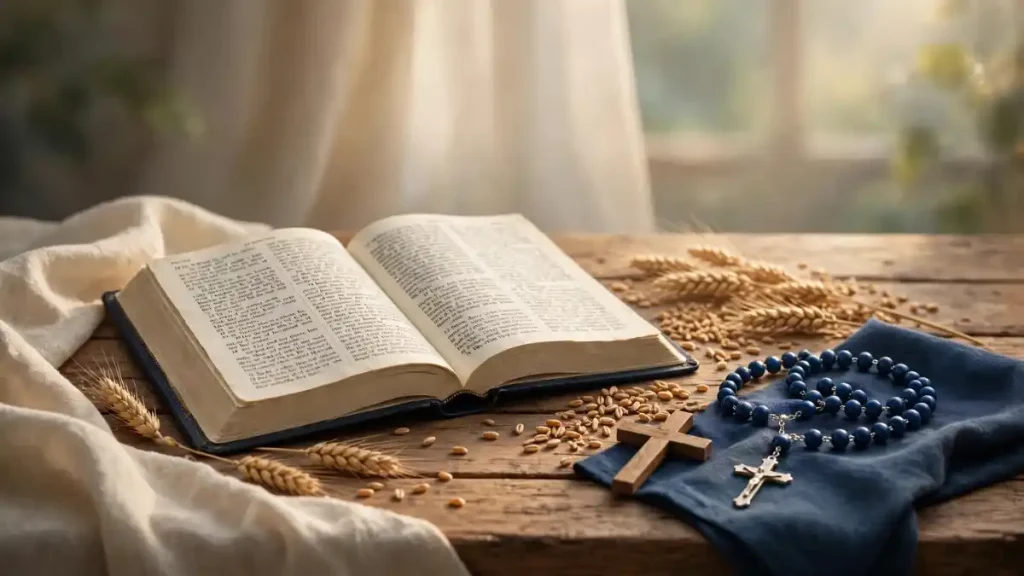
A verse to carry with you
As for that in the good soil, they are those who, hearing the word, hold it fast in an honest and good heart, and bear fruit with patience.
ScriptureLuke 8:15
Catholic Daily Readings for Saturday, 19 September 2026, speak about seeds, soil, death, and new life. Saint Paul uses the seed to explain the resurrection of the body. Jesus uses the same image to reveal how God’s Word enters the human heart. On the Optional Memorial of Saint Januarius, we also remember that a life planted faithfully in Christ can bear fruit across many generations.
Saint Paul compares the resurrection of the body to a seed planted in the earth. What is sown in weakness and corruption will be raised in power and new life. As we have carried the image of the earthly man, we are called to bear the image of the heavenly man.
Brethren: Someone will ask, “How are the dead raised? With what kind of body do they come?” You foolish person! What you sow does not come to life unless it dies. And what you sow is not the body that is to be, but a bare seed, perhaps of wheat or of some other grain. So is it with the resurrection of the dead. What is sown is perishable; what is raised is imperishable. It is sown in dishonour; it is raised in glory. It is sown in weakness; it is raised in power. It is sown a natural body; it is raised a spiritual body. If there is a natural body, there is also a spiritual body. Thus it is written, “The first man Adam became a living being”; the last Adam became a life-giving spirit. But it is not the spiritual that is first but the natural, and then the spiritual. The first man was from the earth, a man of dust; the second man is from heaven. As was the man of dust, so also are those who are of the dust, and as is the man of heaven, so also are those who are of heaven. Just as we have borne the image of the man of dust, we shall also bear the image of the man of heaven.
Response: I will walk in the presence of God, in the light of the living.
Jesus tells the parable of a sower whose seed falls on a path, rocky ground, among thorns, and finally into good soil. The seed is the Word of God. The fruitful hearer receives it with a generous heart, holds it firmly, and bears fruit through perseverance.
At that time: When a great crowd was gathering and people from town after town came to Jesus, he said in a parable, “A sower went out to sow his seed. And as he sowed, some fell along the path and was trampled underfoot, and the birds of the air devoured it. And some fell on the rock, and as it grew up, it withered away, because it had no moisture. And some fell among thorns, and the thorns grew up with it and choked it. And some fell into good soil and grew and yielded a hundredfold.” As he said these things, he called out, “He who has ears to hear, let him hear.” And when his disciples asked him what this parable meant, he said, “To you it has been given to know the secrets of the kingdom of God, but for others they are in parables, so that ‘seeing they may not see, and hearing they may not understand’. Now the parable is this: The seed is the word of God. The ones along the path are those who have heard; then the devil comes and takes away the word from their hearts, so that they may not believe and be saved. And the ones on the rock are those who, when they hear the word, receive it with joy. But these have no root; they believe for a while, and in time of testing fall away. And as for what fell among the thorns, they are those who hear, but as they go on their way they are choked by the cares and riches and pleasures of life, and their fruit does not mature. As for that in the good soil, they are those who, hearing the word, hold it fast in an honest and good heart, and bear fruit with patience.
A farmer gave his son a small piece of land and a bag of good seed. The young man scattered the seed but did not remove the stones, break the hard ground, or pull out the weeds. Weeks passed, and very little grew. He returned the empty bag to his father and complained, “These seeds were useless.” The father took him back to the field, lifted a stone, and uncovered a thin root struggling beneath it. The seed had tried to grow. The ground had given it no room.
Jesus tells us that the seed is the Word of God. The problem in the parable is never the seed. God’s Word carries life within it. The difference lies in the soil that receives it. One heart is hardened by repeated refusal. Another receives the Word with quick joy but gives it no roots. Another allows anxiety, wealth, pleasure, and endless desire to choke what God has planted.
The good soil is not a person without weakness. Jesus describes it as a heart that receives the Word, holds it firmly, and bears fruit through perseverance. This is important. Spiritual fruit does not appear through passing emotion. It grows when grace is welcomed again and again through prayer, the sacraments, obedience, repentance, and works of love.
The First Reading carries the image of the seed even deeper. Saint Paul uses it to explain the resurrection of the body. A seed placed in the earth seems to disappear, but God raises from it a form of life greater than what was buried. Paul does not teach that the body is worthless or that salvation means escaping from it. The body is sown in weakness and raised by God’s power. The person who dies remains the person whom God raises, but that life is transformed and made fit for glory.
For this reason, Christian burial is an act of hope. We place the body in the earth like a seed, trusting not in nature alone but in the God who raised Jesus. Death is real, and grief is real. Yet neither has the final word. Christ has entered death and turned the grave into ground awaiting resurrection.
Saint Januarius lived this hope. He could have protected his earthly life by denying Christ, but he believed that his life belonged to the risen Lord. His martyrdom was not a love of death. It was confidence that death could not separate him from Christ. His witness, planted in blood, continued to strengthen the faith of generations.
Our hearts may contain all four kinds of soil. We may be open to God in one area and resistant in another. A person may pray faithfully but refuse forgiveness. Another may hear the Gospel gladly but allow worry to rule every choice. The honest question is not merely, “Did I hear God’s Word today?” It is, “What kind of welcome did I give it?”
Choose one stone or thorn to remove today. It may be resentment, constant distraction, hidden dishonesty, fear, or a habit that weakens prayer. Do not try to repair the whole field in one morning. Open one place where the Word can take root. God supplies the seed and the life within it. Our task is to receive, protect, and patiently obey.
Lord Jesus, Your Word carries the life my heart needs. Break the hard places within me, remove the stones of resistance, and free me from the thorns that choke faith. Give me a generous heart that receives Your Word, holds it firmly, and bears fruit through patient obedience. Strengthen my hope in the resurrection of the body and the life of the world to come. Through the prayers of Saint Januarius, give me courage to remain faithful when following You becomes difficult. Amen.
Today the Church remembers Saint Januarius, an early Christian bishop and martyr traditionally connected with Benevento and Naples. He gave his life during the persecution associated with Emperor Diocletian. Saint Januarius is the principal patron of Naples, where his relics are honoured with deep devotion. His martyrdom reminds us that faith planted in Christ can bear fruit long after a faithful person’s earthly life has ended. Read the life, martyrdom, patronage, and prayer of Saint Januarius here.
Thank you for praying with us today. Please share these Catholic Daily Readings with someone you love, and join our WhatsApp channel for daily updates. 🙏❤️🙏
Welcome to today’s Catholic Daily Readings for Tuesday, 29 September 2026. Sit with the Word, and...
Read More →
Welcome to the Catholic Daily Readings for Monday, 28 September 2026, a weekday of Ordinary Time...
Read More →Catholic Daily Readings for Sunday, 27 September 2026, invite us to move beyond good words and...
Read More →Choose one simple response after prayerful reading.