
Sunday Homily for the 26th Sunday in Ordinary Time
Sunday Homily for the 26th Sunday in Ordinary Time asks a difficult question: Is our faith...
Read More →
Friday of the Thirty-First Week in Ordinary Time
Luke 16:1–8
Jesus tells one of His strangest parables about a manager who gets caught stealing from his boss. When he’s about to be fired, he quickly goes to all his master’s debtors and reduces their bills – basically giving away his boss’s money to make friends who will help him when he’s unemployed.
The shocking part? His boss actually praises him for being shrewd! Not for being honest (he wasn’t), but for being smart about his future.
Then Jesus says something that sounds almost insulting: “The children of this world are more shrewd in dealing with their own generation than the children of light.”
Jesus isn’t teaching us to cheat or be dishonest. He’s teaching us something much more important: urgency and foresight.
The crooked manager finally realized something crucial: his time was up, judgment was coming, and he needed to act fast. So he used the resources he had left to secure relationships that would help him in his uncertain future.
Jesus is saying: “Look how smart this dishonest guy was about planning for his earthly future. Why aren’t you Christians that smart about planning for eternity?”
Here’s the key idea: Turn temporary resources into eternal relationships.
The steward used money (which he was going to lose anyway) to create friendships (which would help him later). Similarly, we should use our temporary earthly resources to build eternal relationships with God and others.
Convert your resources:
When you do this, you’re storing up treasure in heaven and building relationships that will matter forever.
The steward finally believed the audit was real. He stopped pretending he could avoid consequences and started preparing for what was actually coming.
Disciples need to do the same. We know these truths but often live like they’re not real:
Worldly people are often smarter about their earthly futures than Christians are about their eternal futures. They save for retirement, buy insurance, plan for emergencies – but we sometimes act like eternity will just take care of itself.
Before making decisions about your money, time, or influence, ask:
How can I use what I have to help people who really need it? This isn’t just about money – it’s about using whatever resources you have (connections, skills, time, influence) to lift up people who can’t repay you.
Will this choice matter in eternity? Am I investing in things that will disappear, or things that will last forever? Relationships, acts of mercy, and spiritual growth are eternal investments.
Turn spending into giving.
Look at your budget and find one expense you can reduce or eliminate this month. Instead of spending that money on yourself, give it to someone who really needs it – a struggling family, a food pantry, a homeless shelter, or a charity that helps the poor.
Be specific: “Instead of eating out twice this week, I’ll cook at home and give that $40 to help someone buy groceries.”
Use your influence for others.
Think about your network of friends, family, coworkers, and acquaintances. Who do you know who could help someone else? Make an introduction, recommend someone for a job, connect someone who needs help with someone who can provide it.
The key is helping someone who can’t do anything for you in return – that’s how you know you’re storing up treasure in heaven instead of just networking for earthly benefit.
Set up a regular spiritual practice.
Choose one concrete way to regularly invest in your eternal future:
Make it specific, regular, and focused on growing closer to God and serving others.

The steward used his boss’s money to make friends who would “receive him into their homes” when he lost his job.
Jesus wants us to use our earthly resources so wisely that when we die, the people we’ve helped will “receive us into the eternal dwellings” – welcoming us into heaven because our generosity helped them get there too.
Imagine arriving in heaven and having people say, “I’m so glad to see you! Your kindness helped me through the hardest time in my life” or “The way you served the poor showed me what God’s love looks like.”
The world teaches us to be smart about money, careers, and earthly success. Jesus teaches us to be even smarter about eternity.
Don’t just live for today or even for retirement. Live for forever. Use your temporary resources to build permanent relationships. Spend your earthly wealth in ways that create heavenly friendships.
Be shrewd for the kingdom. Spend today so that someone thanks God for you in the eternal dwellings.
Lord Jesus, help us be as smart about eternity as worldly people are about earthly things. Show us how to use our money, time, and influence to help others and store up treasure in heaven. Give us the urgency to act now, knowing that judgment is real and our time is limited. Help us turn our temporary resources into eternal relationships through generosity and service. Make us shrewd for Your kingdom, not for our own gain. Amen.
❤️ Thank You dear friend, hope this reflections touched you. 🙏 Please do not forget to share with your loved ones this november 7 homily.
If you like Catholic Homily for november 7, 2025, do not forget to give your comment below. And please 🫂 join our whatsapp channel for everyday 🔔 update 👇👇👇

Sunday Homily for the 26th Sunday in Ordinary Time asks a difficult question: Is our faith...
Read More →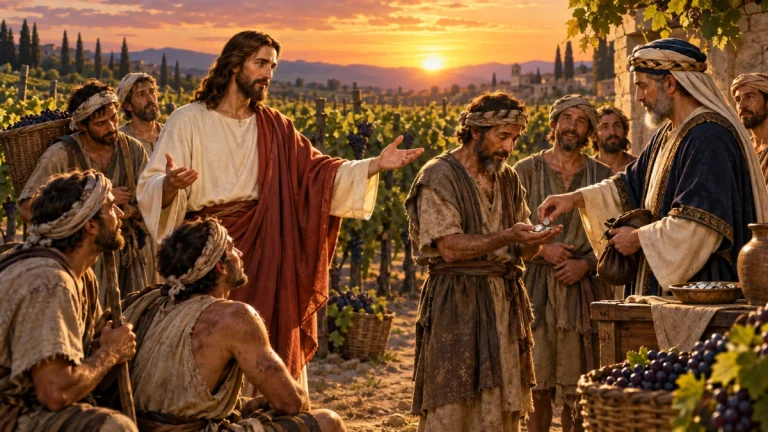
Sunday Homily for the 25th Sunday in Ordinary Time invites us into a vineyard where God’s...
Read More →
A warm homily on fraternal correction for the 23rd Sunday in Ordinary Time, Year A, with...
Read More →Choose one simple response after prayerful reading.