Some saints are born quietly holy. Saint John Gualbert was not. He was a young nobleman on his way to commit murder when God stopped him cold on a narrow road, and the mercy he showed that day changed the rest of his life. His story is one of the great Catholic pictures of forgiveness. This saint’s feast falls on 12 July.
Who Was Saint John Gualbert?
Saint John Gualbert was an 11th-century Italian monk, the founder of the Vallombrosan order and a tireless reformer of the Church. He is best remembered for one dramatic act of forgiveness that turned a man bent on revenge into a servant of God. He is the patron saint of foresters and park rangers, and his feast day is 12 July.
Early Life
John was born around the year 995 into a noble family near Florence, Italy. He grew up as young noblemen of his time did, trained in arms and expected to defend the honour of his family. It was a world where a wrong done to your blood demanded revenge, and John was raised to answer that call without hesitation.
Conversion or Call to Holiness
The turning point came on Good Friday. John’s brother Hugh had been murdered, and John rode out determined to kill the man responsible. On a narrow road he met him face to face, with no room to escape. John drew his sword.
But the man didn’t run. He dropped to his knees, spread his arms wide in the shape of the cross, and begged for mercy in the name of Christ, who died that very day. John froze. He could not raise his sword against a man kneeling like the crucified Lord on the day of the Lord’s own death. He lowered the blade, forgave the man, and let him go.
Still shaken, John went into a nearby church to pray before a wooden crucifix. The old tradition says the figure of Christ bowed its head to him, as if in thanks for the mercy he had shown. John walked out a changed man. He cut his hair, put on a simple habit, and gave himself to God.
Mission and Major Works
John first became a monk at San Miniato, but he longed for a stricter, simpler, more honest way of life. He searched until he came to a shaded valley in the hills above Florence called Vallombrosa. There he gathered men who wanted what he wanted: hard work, deep silence, real poverty, and constant prayer, a true return to the Rule of Saint Benedict.
That community became the Vallombrosan order, which spread across Italy. John also threw himself into the great reform battle of his age, fighting fiercely against the buying and selling of Church offices. He had given up personal revenge, but he never gave up the fight for a pure and honest Church.
Virtues and Spirituality
John’s whole life turned on one virtue: mercy. The forgiveness he showed on that road became the shape of everything after it. Alongside it stood a deep love of poverty, humility, and reform. He wanted the Church clean and the monastic life simple, and he lived what he preached, choosing hardship over comfort to the end of his days.
Miracles or Important Events
The most famous event of his life is the bowing crucifix at San Miniato, remembered ever since as a sign of God’s pleasure in his mercy. Various miracles were attributed to him during his life and after his death, and his reputation for holiness spread quickly. He was canonised in 1193, barely more than a century after he died.
Feast Day
Saint John Gualbert’s feast day is celebrated on 12 July, the day of his death.
Patronage
He is the patron saint of foresters and park rangers, a patronage tied to the woodlands around his monasteries, which his monks tended and loved. Pope Pius XII made this patronage official in 1951.
Symbols and Representation
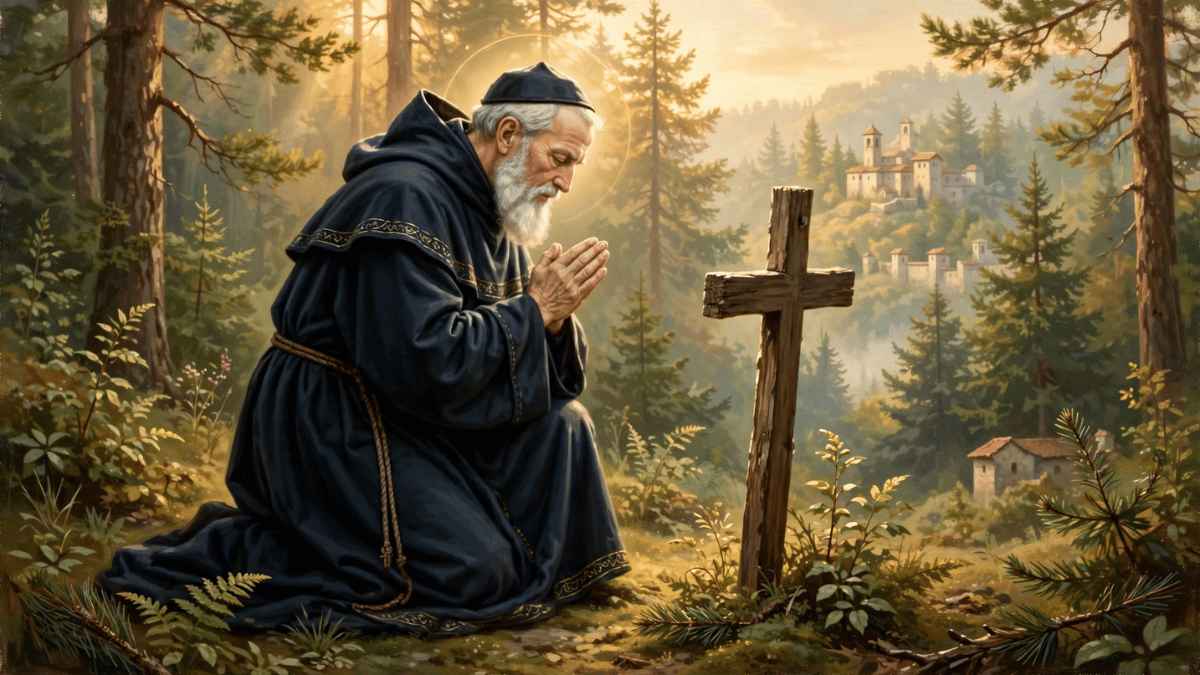
In sacred art John is usually shown in the habit of his order, often near a crucifix, recalling the bowing figure of Christ. He is sometimes pictured with a man kneeling before him in forgiveness, or in a forest setting that points to his patronage.
Lessons from the Saint’s Life
Most of us are never handed a literal sword. But nearly all of us are handed the chance for revenge: the cutting reply, the grudge we nurse for years, the person we’ve decided never to forgive. John’s story speaks straight to that. He had every right and every reason, and he put the sword down anyway, because he had met the mercy of Christ and could not un-meet it. If you’re holding a grudge that’s turning your heart to stone, John Gualbert is your saint. He proves that the hardest ground can still go soft.
Prayer to Saint John Gualbert
Saint John Gualbert, on a narrow road you raised your sword, and the mercy of Christ made you lower it. When I am tempted to pay back the hurt done to me, remind me of the Lord who forgave from the cross. Soften whatever has gone hard in my heart, and give me the courage to forgive. Pray for me. Amen.
Conclusion
Saint John Gualbert began his most famous day as a man hunting revenge and ended it as a man kneeling before a crucifix. That single act of mercy grew into an order, a reform, and a witness that has lasted a thousand years. His life is proof that God can stop any of us on our own narrow road and turn even a hardened heart into good soil.
Saint John Gualbert’s feast is 12 July. Read the Catholic Daily Readings for that day here.