
Saint Lawrence Ruiz
He was an ordinary husband and father who never set out to be a hero. He...
Read More →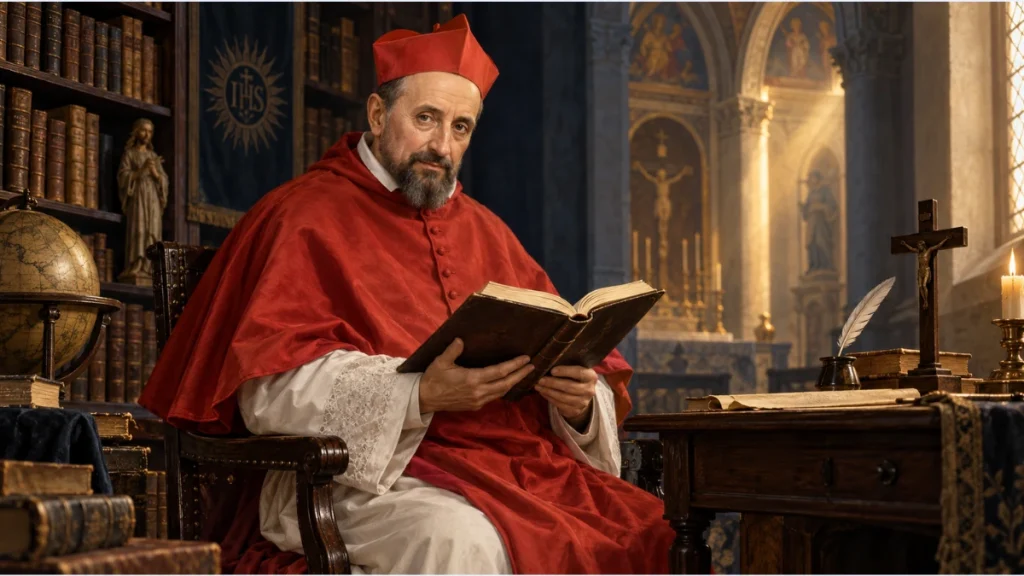
Saint Robert Bellarmine possessed one of the sharpest minds of his time, yet he never treated knowledge as a throne. For him, learning had to kneel before God, serve ordinary people, and lead to a holy life. He became a Jesuit priest, gifted teacher, cardinal, archbishop, writer, and Doctor of the Church. Read today’s Catholic Daily Readings here.
Saint Robert Bellarmine was a sixteenth-century Italian Jesuit, priest, theologian, cardinal, and archbishop. He served the Church during the difficult years following the Protestant Reformation and the Council of Trent.
He became known for explaining and defending Catholic teaching with clarity. Yet his deepest concern was not winning arguments. He wanted people to know Christ, understand their faith, pray faithfully, and live holy lives.
The Church celebrates his optional memorial on 17 September, the date of his death in 1621.
Robert Bellarmine was born on 4 October 1542 in Montepulciano, Italy. He received a strong education in language, literature, philosophy, and theology.
As a young man, he felt called to religious life and entered the Society of Jesus on 20 September 1560. His family had hoped that his intelligence might bring him honour and success. Robert chose a different road. He wanted his gifts to belong to God.
He studied at the Roman College, Padua, and Louvain. His studies of Saint Thomas Aquinas and the Fathers of the Church shaped his understanding of Catholic teaching.
Robert was ordained a priest on 25 March 1570. He taught theology at Louvain before being called to teach at the Roman College.
The Church was facing deep disagreement over Scripture, the sacraments, authority, grace, and the nature of the Church. Robert studied these questions with great care. His lectures became a major work commonly called the Controversies.
He defended Catholic doctrine firmly, but he tried to avoid an angry and insulting style. He studied history, Scripture, reason, and Church Tradition so that his explanations would be clear and fair.
Saint Robert could write for scholars, but he also understood the needs of children and ordinary families. He prepared a short catechism of Christian teaching during the years 1597 and 1598.
The work became one of his most widely used books. It explained the faith through clear questions and answers. Robert believed that deep truth did not need confusing words. A good teacher should make truth easier to understand without making it weaker.
His example still speaks to parents, priests, catechists, and teachers. Knowing a subject is not enough. A teacher must also know how to bring that knowledge within the reach of another person.
Pope Clement VIII made Robert a cardinal in 1599. He was appointed Archbishop of Capua in 1602 and received episcopal ordination that same year.
He did not treat the diocese as an office that could be managed from a distance. He preached in his cathedral, visited parishes each week, held diocesan synods, and worked for the renewal of clergy and people.
The great scholar became a travelling pastor. He knew that Church teaching had to reach villages, parishes, families, and wounded lives.
Robert carried many responsibilities, but he did not allow work to replace prayer. He believed that prayer gave life and direction to every duty.
He wrote that “whoever finds God finds everything, whoever loses God loses everything.” These words reveal the centre of his life. Knowledge, honour, health, and success could never replace friendship with God.
He also served as the spiritual director of Jesuit students at the Roman College. Among them was Saint Aloysius Gonzaga. Robert guided young religious not only through lessons, but also through prayer and personal care.
Saint Robert lived during a time when many people spoke loudly about reforming the Church. He agreed that renewal was needed. But he taught that true reform must begin with the conversion of one’s own heart.
It is easy to list the failures of leaders, priests, families, schools, and communities. It is harder to ask, “What must change within me?” Robert did not separate Church renewal from personal holiness.
He encouraged simple living, charity, serious prayer, and regular examination of life. His learning remained joined to a daily struggle to follow Christ.
Saint Robert Bellarmine died in Rome on 17 September 1621. He was beatified in 1923 and canonised by Pope Pius XI in 1930.
In 1931, Pope Pius XI declared him a Doctor of the Church. This title recognises saints whose teaching has given lasting help to the whole Church.
His books belong to another age, but his central message remains fresh: truth must lead to Christ, knowledge must serve love, and Church renewal must begin in the human heart.
Saint Robert teaches students and scholars that intelligence is a gift to be used humbly. Learning should lead us toward truth, not pride.
He teaches priests and teachers to explain difficult truths in simple language. People should not be made to feel small because they do not understand a complicated explanation.
He teaches Church leaders to remain close to their people. Titles and offices have value only when they become ways of serving.
Above all, he asks each person to begin reform at home. Before correcting the whole world, we must allow Christ to correct our hearts.
Saint Robert Bellarmine, you placed your great learning at the service of Christ and His Church. Pray that we may seek truth with humility and explain our faith with patience and love. Help students, teachers, catechists, priests, bishops, and all who serve through knowledge. Teach us to begin every reform with our own conversion and to keep prayer at the heart of our work. Saint Robert Bellarmine, pray for us. Amen.
Saint Robert Bellarmine shows that a brilliant mind becomes truly great when it serves God and His people. He studied deeply, taught clearly, prayed faithfully, and served closely.
His life leaves us with a simple question. Is what we know making us proud, or is it helping us love and serve more faithfully?
Share the story of this holy teacher, and pray with today’s Catholic Daily Readings. 🙏❤️🙏

He was an ordinary husband and father who never set out to be a hero. He...
Read More →
Saints Cosmas and Damian were Christian physicians who treated the sick without asking for payment. Their...
Read More →
Saint Pio of Pietrelcina spent much of his life in one quiet friary, yet people travelled...
Read More →Choose one simple response after prayerful reading.